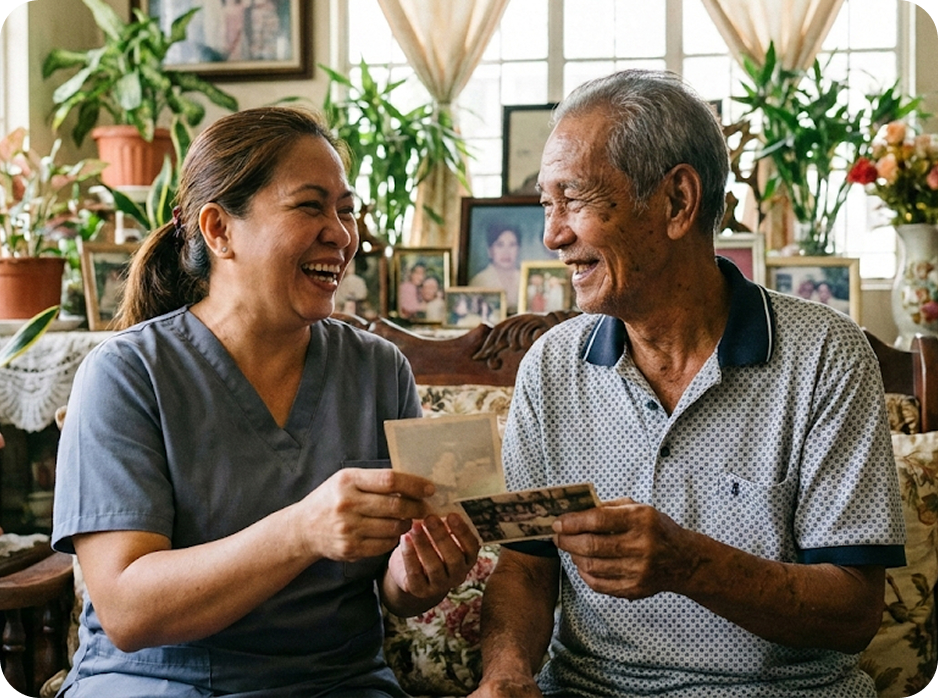
Cognitive decline changes how a person communicates, processes routine, and manages emotion. For many immigrant families, it also brings a return to a first language — and a heightened need for culturally familiar faces and communication styles. Carely caregivers are trained in dementia-aware support that prioritizes calm, consistency, and cultural alignment.
| THE CARELY DIFFERENCE
“Redirects gently. Keeps the routine moving. Doesn’t engage in a reality the senior can’t access.” Agitation decreases. Daily tasks get done. The senior feels oriented, not embarrassed. |
Dementia & Alzheimer’s Communication
Carely caregivers use calm communication, short explanations, and respectful repetition. They do not argue, correct, or escalate when a senior is confused or resistant. The focus is on reducing agitation and maintaining cooperation with daily routines through tone, pacing, and predictability. Caregivers follow family guidance on what is reassuring versus triggering, and they check in regularly so care stays aligned with how the senior’s condition is evolving.
First-Language Support for Cognitive Decline
Seniors with dementia often revert to a first language under stress or confusion — even if they have spoken English fluently for decades. A caregiver who can communicate in that language is not a convenience; it’s a clinical advantage. Carely prioritizes language-matched caregivers for clients with cognitive decline, and we explain this clearly to families during placement.
Routine Stabilization
Familiar routines are one of the most effective tools for managing dementia-related agitation. Carely caregivers maintain consistent daily structures — wake times, mealtimes, personal care routines — that reduce confusion and help the senior feel oriented. We do not introduce unnecessary variation. When schedules must change, caregivers use calm, clear communication to ease transitions and minimize distress.
Wandering & Safety Supervision
For seniors at risk of wandering or unsafe behavior, Carely caregivers provide attentive supervision that is watchful without being restrictive. The goal is to reduce risk while preserving as much independence and dignity as possible. Families are kept closely informed of changes in behavior or new safety concerns so the care plan can be updated before a situation escalates.
| Important: Carely provides non-medical memory care support only. We do not diagnose, assess, or treat cognitive conditions. Families should work with a physician or neurologist for clinical evaluation and medical care. Carely’s role is to support safe, stable, and dignified daily living alongside that clinical relationship. |